Tuesday, June 15, 2010

Day 348 - Valldemossa

We decided to rent a car for a week and tour Mallorca. Our first series of stops were along the west coast, in the Tramuntana Mountains. The first town we stopped in was Valldemossa, a quaint village. It has a famous monastery where Chopin lived during the winter of 1838/39. The houses are constructed of stone and the village provides a pleasant backdrop for an afternoon stroll and lunch.


All the houses have ornamental entrances with flowers, green shutters and small ceramic plates at the main entrance. Apparently the plates contain a prayer message to La Beata, the saint protecting the village. This village is very relaxing and well worth the visit.


After lunch we decided to check out the Port de Valldemossa, located several kms away. The guide book described the drive to the port as 'tortuous.' That is quite an understatement. Barely wide enough for a single car, the road is a long, twisting, narrow journey of frayed nerves - the longest 7km drive of my life. Not for the faint of heart.


After the crazy, stressful drive down the side of the mountain to get to the port we were hoping for something amazing (magic dancing unicorns?), but there isn't much there except a restaurant and half naked fishermen. Huh. So the port was a bit of a letdown.


Day 347 - La Seu Cathedral


The main attraction in Palma, Mallorca is La Seu Cathedral, a magnificent gothic cathedral, constructed between 1229 and 1601, with reconstruction work ongoing through the early 20th century. Situated an a hill along the coast, the cathedral dominates the landscape. It is an impressive sight when it first comes into view.


There are many interesting features of the cathedral, but the most impressive is the sun falling through the stained glass windows, filling the cathedral with mysterious, soft, warm light. My attempt to capture the light quality, handheld at high ISO, does not do the interior justice. Nonetheless, it is understandable that the cathedral is commonly referred to as 'The Cathedral of Light.'

Monday, June 14, 2010

Day 346 - Bellver Castle

After Barcelona we decided to take in some downtime on Mallorca, a Spanish Island located in the Mediterranean, part of the Balearic Islands. We booked a cheap flight to Palma, the lone city on the Island. Before renting a car to escape to more serene settings we took some time to explore the island's capital.


Compared to the beautiful northwest coast of the Island Palma is less impressive. It is a port city and its charms less obvious. However, we were only passing through, so we did not expect much. The Island's capital does have two noteworthy sights, the Bellver Castle and the Cathedral. First up is the Bellver castle.


The Belver castle is a gothic style castle on a hill overlooking the city. The view of the city from the castle is quite lovely and the castle design itself is interesting. Built in the 14th century, it is one of the few circular castles in Europe. It served as a military prison throughout the 18th to mid-20th century, and now mostly serves as a history museum. I enjoyed shooting the various archways throughout the interior.


Sunday, June 13, 2010

Day 345 - Palau Musica de Catalana

The Palau Musica de Catalana is a concert hall designed by architect Lluis Domenech Montaner (not Gaudi!) that opened in 1908. This building is the headquarters of "Orfeó Catala", a prestigious institution founded in 1891 to support Catalan music and culture.

The concert hall of the Palau is an awesome spectacle. It is illuminated virtually entirely in natural light, via ornate stained-glass panes. The centerpiece is an enormous inverted dome skylight designed by Antoni Rigalt, in shades of gold surrounded by blue, that suggests the sun and the sky. The acoustics in the room were quite good but it was the soft magical lighting in the hall that impresses the most.


I was disappointed that photography inside the concert hall is not permitted. That the owners choose to limit photography of such a magnificent building, which is virtually a shrine to light and creative artistic achievement, is a shame in my opinion. A more reasonable policy has been adopted in the Gaudi exhibits, which allows photography but restricts usage of images for commercial purposes. I took the image above 'from the hip' so it is not well composed, and will take it down if asked, but I maintain that such a policy is just plain silly - I have no intention of selling this image.

The facade of the exterior of the building is interesting but very difficult to photography given the narrow streets that surround the building. The exterior is mostly memorable for the floral designs. The appearance was a bit too much like a wedding cake for my taste, but still quite interesting.

Day 344 - Las Ramblas

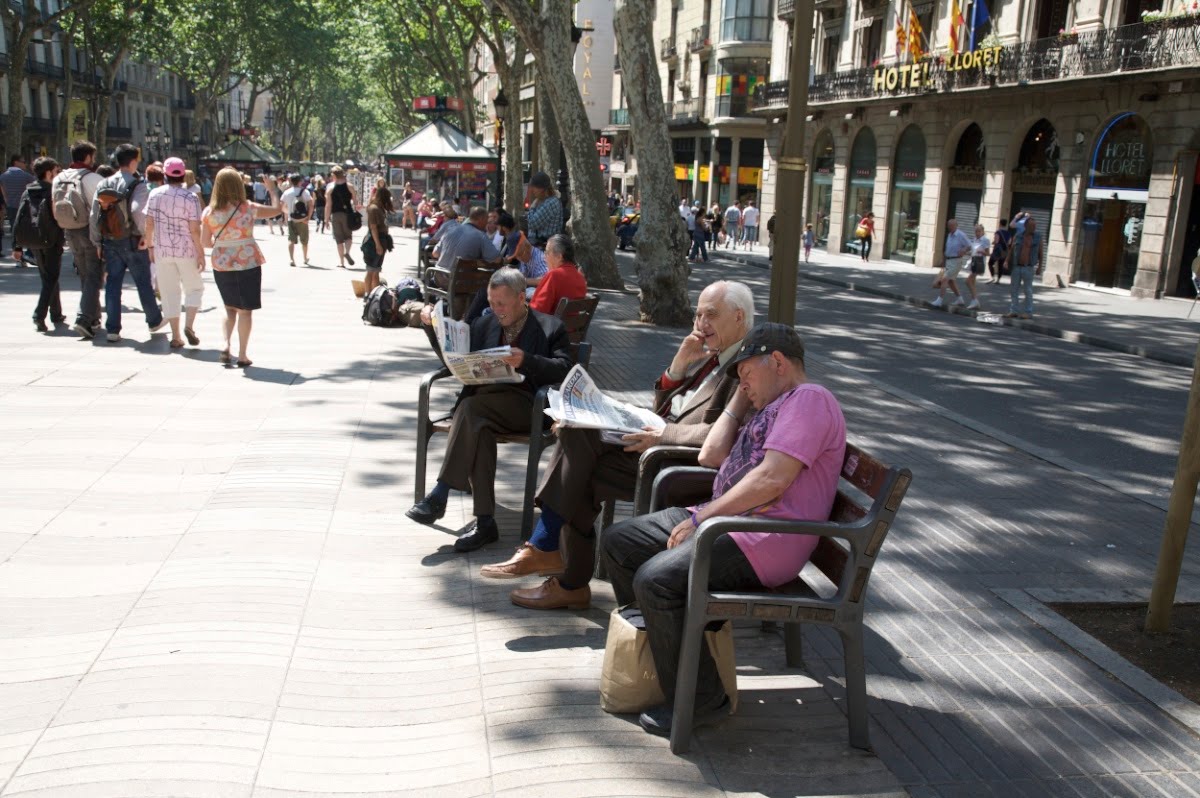
La Rambla is a popular 1.2 km tree-lined street in central Barcelona. La Rambla is actually a series of shorter, connected streets, and is thus referred to as 'Las Ramblas' in Spanish.


Las Ramblas is a crowded street that increasingly caters to tourists. You will likely find more tourists than locals, and thus the street has lost much of its authentic, local character. Food quality is poor, prices are very high, and the street is filled with a carnival type atmosphere. Despite its popularity among tourists, I disliked this street more with each walk, and we eventually avoided it altogether. The best part of the street are the trees, which are very pretty.


At the bottom of La Rambla is a bike station, which showcases Barcelona's latest public transit system, a community bike program called 'bicing.' With over 200 bike stations located across the city, local residents can grab a bike just about anywhere in the city. For 30 euros a year, residents get a card and can access the bikes for travel in the city up to 2 hours at a time. Genius! Unfortunately bicing is presently only available for local residents. We could have used one of these bikes on a number of occasions.

Day 343 - Casa Milà

Casa Milà, also known as La Pedrera, is a building designed by Antoni Gaudi, built between 1905-1910, located in the Eixample district of Barcelona. The house was built for built for a married couple, Rosario Segimon and Pere Milà.


Like much of Gaudi's work, the building was controversial in its day. The municipality objected to much of the project, fined the owners for various building code infractions and ordered various aspects of the project to be demolished. The building grew into disrepair until the 1980's but has since been restored and is now a UNESCO World Heritage Site.


The highlight of the building is the rooftop. The surface of the roof is covered with undulating slopes and odd chimneys designed in fantastical shapes. They remind me of scary, gothic comic book figures.

Day 342 - Font Màgica

Font Màgica is Barcelona’s largest ornamental fountain. It was built in 1929 for the International Exhibition, and offers a spectacular display of light, music and water.


I have been fortunate to see two amazing water, light and music shows this year. Font Magica is not quite on par with the water display at the Bellagio in Las Vegas, which I saw on day 54, but is still quite impressive.

Day 341 - Barri Gòtic

Our favourite area to stroll in Barcelona was the Barri Gòtic ('Gothic Quarter' in Catalin). This area in the center of the old city is a laybynth of narrow streets, where you can see many buildings dating back to the medieval times.


The maze of streets that make up the Barri Gotic make navigation all but impossible, and we got lost nearly every time we went for a walk, but that was part of the fun. Sooner or later you end up at a familiar square, and along the way you get to see interesting buildings and shops.


There are many historic points of interest in the Barri Gotic. One of the most amazing sights is the Cathedral of the Holy Cross and Saint Eulalia, constructed between the 13th-15th centuries. Unfortunately, the cathedral's exterior had alot of staging and was not great for photographing, but the inside did not disappoint. It is visually stunning and immense in scope. No shortage of photos ops.


Another pretty church is Santa María del Pí (Blessed Lady of the Pine Tree), a 14th century gothic church situated on the Placa del Pi.


Carrer del Bisbe Irurita is a charming street that runs alongside the cathedral. This narrow street, like many streets in the Barri Gòtic, is closed to traffic and is designated for pedestrian traffic only. There is a beautiful archway/walkway that crosses the street.


Plaça Reial (Royal Plaza) is one of the most famous squares in the Barri Gòtic. It is a well-known tourist attraction, especially at night. Dotting the square are a large number of restaurants and clubs. In my opinion the cost of food is high and the quality is not that great so I consider this area best only for enjoying the ambience.


The Barri Gotic is also a great place to stroll at night. So long as you stick to the main streets there are many good tapas restaurants and bars to choose from.

Wednesday, June 9, 2010

Day 340 - Parc Güell

Parc Güell is another popular tourist destination in Barcelona designed by Antoni Gaudi. Built from 1900-1914, the park was originally intended to be a city-garden with houses built for aristorcrats. It failed as a real estate project (only two houses were ever built) and in 1923 the space was transformed into a public park.


The main entrance is at the lowest part of the park. The double staircase has sides with checkerboard tiles and crenelated tops. It is a rather striking staircase in appearance and offers a few colourful sculptures along the way. The downside is that the park is at its most crowded along the staircase, and navigating the crowds of posing tourists can be a bit taxing.


Halfway up the stair, looking back towards the main entrance, you can see two buildings that flank the entrance, the porter's lodge and the office. Both buildings have a gingerbread house appearance (to my eye anyway), with undulating roofs and tall towers. Typical freaky Gaudi.


The 'hypostyle' chamber at the top of the stairs is called the Chamber of the Hundred Columns, although it only has 96. The roof supports the floor of the public square above it. It was originally intended to be a market. To create more space Gaudi eliminated random columns. Josep Maria Jujol, the collaborator on all of the tile work, designed large medallions for the empty spaces in the ceiling.


The wall surrounding the public square above the chamber twists around the plaza and is designed as a long bench for seating. Brightly colored broken tiles create mosaic designs - a technique called trencadis. It is very relaxing to sit and rest on the bench, taking in the vibrant colours and shapes. This bench is probably the most relaxing part of the park.


Circling the outer section of the park are the roadways which were originally intended to service the houses. Separate footpaths formed under these structures, marked by oddly shaped columns.


Tuesday, June 8, 2010

Day 339 - The Boqueria Market


The Mercat de Sant Josep de la Boqueria (aka La Bouqueria), is a popular market in central Barcelona. With an entrance directly off the popular Las Ramblas street, an excellent selection of every food imaginable and a vibrant atmosphere, the Boqueria Market is a 'must see' when visiting Barcelona.


La Bouqueria is by far the largest and busiest markets I have seen. The market is huge, a labyrynth of endless food displays. The selection is fantastic, you can find everything - fruits, vegetables, meats (hanging ham!), fish, nuts, candies, chocolates, wines, coffee, basically everything you can imagine is on display.


The selection of fish in the market was also excellant. There were the familiar selections - Salmon, Prawns, Lobster, Herring, Cod, but also a variety of fish that I did not even recognize. All very fresh.


We couldn't resist buying a couple fruit juices, which we had cravings for every day thereafter while staying in Barcelona.


Despite the size and the hectic crowds the market is very well organized. What struck me the most was how colourful it was, especially in the area of the fruit and vegetable displays. Every single piece of fruit or vegetable seemed strategically placed in a way to make you drool and want to buy something.


There are many stalls selling tapas of authentic Catalin dishes from fresh local ingredients. We felt like a coffee so we decided to kick back and enjoy a cafe con leche (made with strong coffee or espresso with equal parts scalded milk added). The quality of the coffee in Spain is excellent.